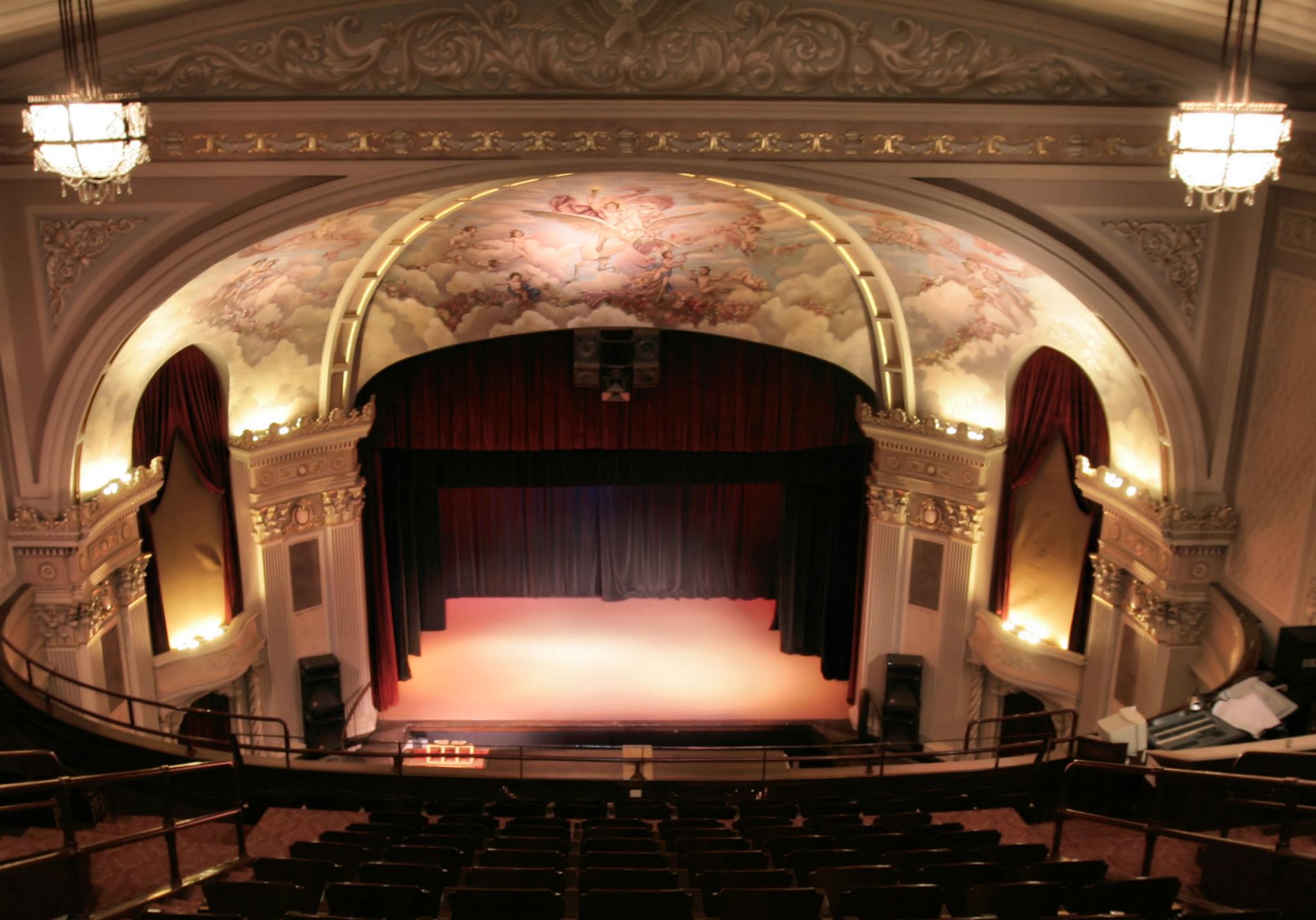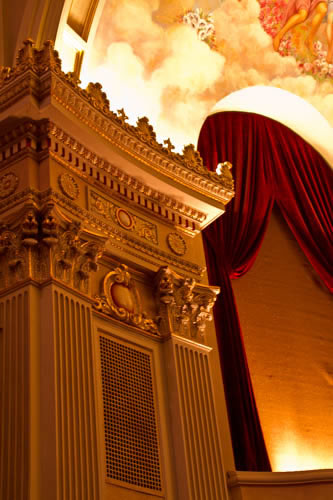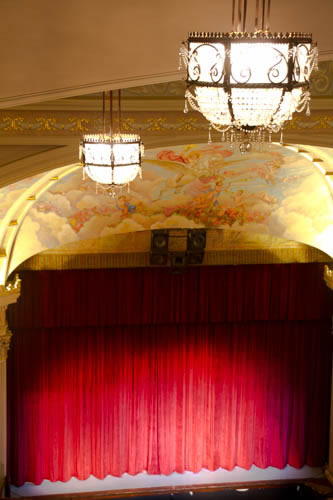
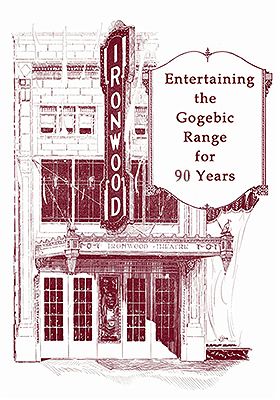
The Ironwood Theatre was built as a vaudeville & silent movie palace in 1928 under the direction of Architect Albert Nelson at a cost of $160,000 (equivalent to approximately $3,100,000 today). Under the leadership of manager A.L. Pikar, the theatre became the center of entertainment in the Ironwood area. The Hollywood Golden Age of the 30s, 40s and 50s followed the Great Depression and the theatre flourished during these decades.
In the early 60s, the Ironwood Theatre was sold to Thomas Theatres of Iron Mountain. The theatre operated as a first run movie house from 1963 until it closed in 1982. It was dark for two years, during which time there was talk of demolition to make room for more downtown parking.
In 1983, owner Thomas Renn gave the Theatre building to the City of Ironwood through the Downtown Ironwood Development Authority (DIDA). Restoration efforts began soon after under the direction of the newly formed Ironwood Theatre Preservation Committee. On January 11, 1985, the Ironwood Theatre was placed on the National Registry of Historic Places.
In 1986, the DIDA was awarded a grant by the State of Michigan, beginning an extensive renovation program that was on-going for nearly 15 years. Renovations completed in the early phase included replacement of the seats in the main auditorium and balcony, lobby & mezzanine carpeting, restoration of the ceiling mural, wall and beam decorations, a new stage floor, updated heating system and upgraded sound system. Later restoration efforts include custom-made organ vent curtains funded by a grant from the Albert W. Cherne Foundation, and ventilation system improvements partly funded by the (then) Michigan Council of the Arts and Cultural Affairs, now known as the Michigan Arts & Culture Council. (M.A.C.C.)
Thanks to the support of the M.A.C.C. and many generous local donors, building improvements and equipment upgrades continue to this day, including energy efficient boilers in 2019 at a cost of $75,000; a state-of-the-art sound system in 2021 at a cost of $84,000, and in 2024, a new lighting control console and digital lighting instruments at a cost of $79,000. In February 2025, the 98-year-old hemp rope and sandbag stage rigging system was replaced with a safer, code-complaint, easier to operate counterweight system, at a cost of more than $300,00 thanks to a $295,000 grant from the Michigan Department of Labor and Economic Opportunity.
The Ironwood Theatre was incorporated in 1988 as an independent, cultural organization, and shortly thereafter was granted 501(c)(3) non-profit status by the I.R.S. The building is leased from the City of Ironwood but ALL operating costs, including productions, and maintenance and repairs of the facility are the responsibility of Ironwood Theatre, Inc. In the absence of local tax support, it is funded by ticket sales, rentals, several annual fund raisers, program grants from a number of private and public foundations, including M.A.C.C., area business support and other fundraising activities. The Ironwood Theatre is a volunteer based organization with an 9-member Board of Directors, two full time staff, more than 30 regular volunteers and more than 120 individuals who volunteer their time and talents because the believe in the theatre and the central role it plays in the cultural life of so many nearby communities.
To listen to Warren Nelson's original song about the Ironwood Theatre, click the Play button [ > ]
The Barton Organ
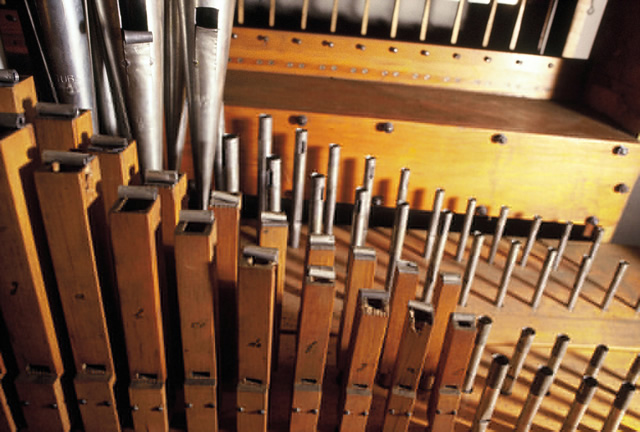
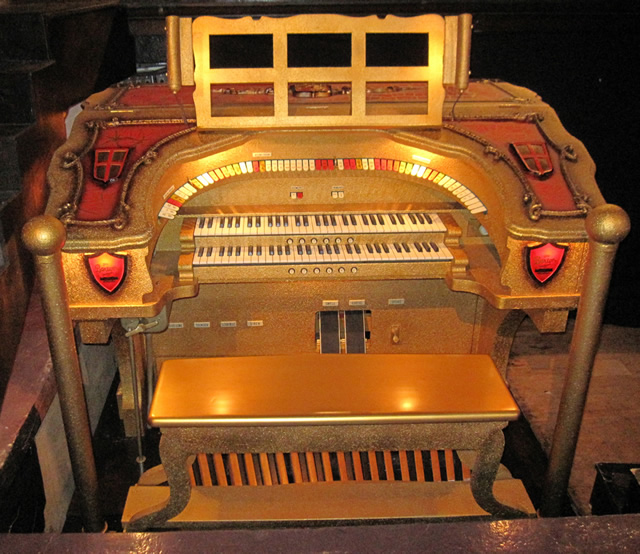
he Bartola Musical Company of Oshkosh, Wisconsin installed more than 350 organs in movie theatres during the silent film era. Of these, the Ironwood Theatre’s Barton is one of only six remaining operable original installations. It is also the newest of the three Bartons in Ironwood (the others were at the Rialto Theatre in 1925 and the Rex Theatre in 1926). The organ is completely intact as it was on opening night in June 1928, when it was first installed.
In 2000, the Board of Directors approved the restoration of the instrument by a group of dedicated volunteers aided and taught by professional technicians.
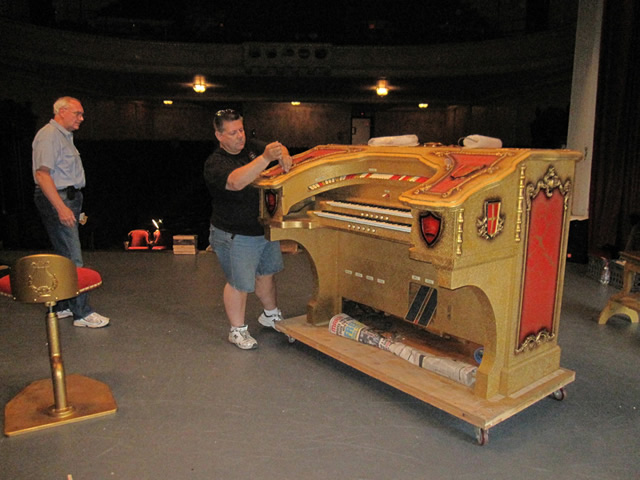
The “Grand Old Lady” is completely playable and is regularly used for concert performances and the accompaniment of silent films at special events. In October of 2009, the console of the organ was removed and sent to the Carlton Smith Pipe Organ Restorations company in Indianapolis, Indiana to undergo further restoration work including refinishing the wood surfaces and repairing damaged ornamentation. The console was returned from restoration and has been installed to original factory specifications. A labor of love that took nearly 13 years to complete, the instrument is now 100% complete and the organ is just as it was when it was originally installed in 1928.
The organ has been awarded registration as a “Heritage Instrument” by the American Theatre Organ Society for its restoration as an original theatre installation. Anyone who has organ playing experience is encouraged to stop by the theatre to come and "tickle the keys of the grand old lady!
The Proscenium Mural
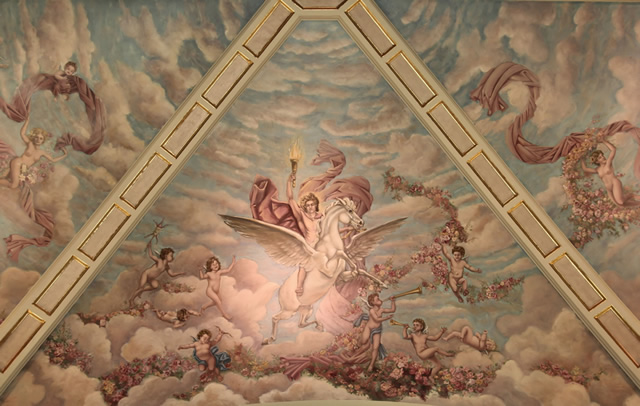
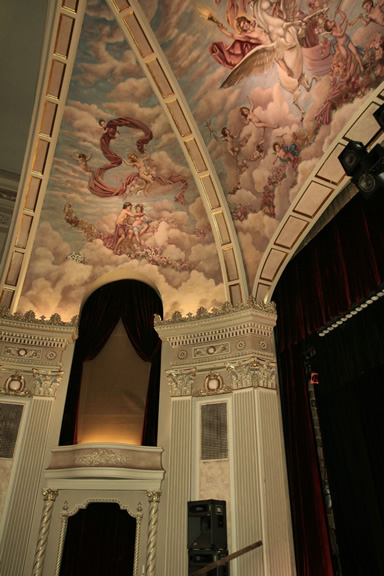
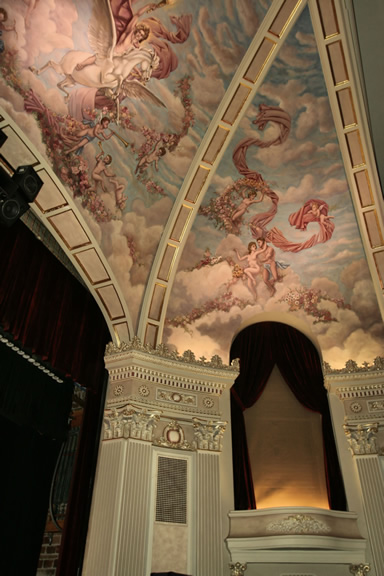
The restored proscenium mural has quite a history of its own. The artistry of the original three-panel mural was designed and painted by William Hasenberg. The mural was painted shortly after the construction phase of the Ironwood Theatre in 1928.
During a somwhat misguided renovation in the early 1970s, the magnificent mural, along with the gold-leaf, plaster ornamentation, and ceilings in the balcony were covered with dark blue paint in an apparent attempt to make the theatre "more modern." Seeing no logic in such action, the restoration committee sought to restore the beautiful mural.
The restoration of the mural began in 1994 with Affiliated Artists as project directors. David Strickland, muralist, monitored the entire restoration process, the first task being the removal of the blue paint without destroying the original mural. The original palette of brighter colors led to a decision to encapsulate the mural and use it as an artistic outline. Strickland and the restoration committee chose new, slightly more muted color values for the historic mural to harmonize with the overall decor of the Theatre. An additional cherub and some floral garland was added on the left to balance the overall composition.